MEMSIC Showcases at World Manufacturing Convention 2026, Empowering Intelligent Upgrade of New Energy Vehicles with MEMS Sensing Technology
Release Time:2026.09.23
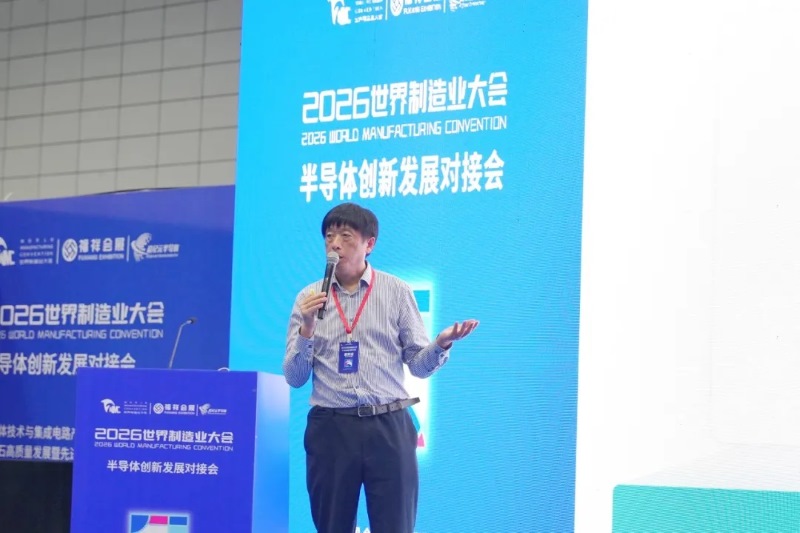
From September 20 to 23, the World Manufacturing Convention 2026 was grandly held in Hefei, Anhui Province. On September 22, MEMSIC participated in the Special Forum on Power Semiconductors, Quartz Materials and New Energy Vehicle Applications held concurrently with the convention. Ju Gao, Director of Application Engineering at MEMSIC, delivered a keynote speech titled Applications of MEMSIC MEMS Sensors in New Energy Vehicles. Centered on sensing demands generated by the intelligent transformation of new energy vehicles, he systematically shared innovative automotive applications and practical results of thermal accelerometers, capacitive accelerometers, AMR geomagnetic sensors and magnetic encoders.
As a premier manufacturing event with far-reaching international influence, the World Manufacturing Convention brings together participants from global industries, academia and research institutes. It showcases cutting-edge technologies, latest achievements and emerging trends in advanced manufacturing, serving as a high-level platform to deepen industrial exchanges and foster collaborative innovation. Under the theme of Smart Manufacturing for a Better World, the 2026 convention featured keynote speeches, supply-demand matching along industrial and supply chains, major project matchmaking, authoritative releases and achievement exhibitions, presenting new progress in the intelligent, green and integrated development of global manufacturing.
New Energy Vehicles Unlock New Application Space for MEMS Sensors
As the automotive industry rapidly advances toward electrification and intelligence, vehicles are evolving from traditional transport tools into smart terminals integrating sensing, computing and control capabilities. Demand for sensing vehicle motion status, attitude, position and angle information keeps rising, expanding MEMS sensor applications beyond conventional safety systems to intelligent chassis, smart cabin, smart keys, ADAS and more scenarios.
Ju Gao noted in his speech that MEMSIC entered the automotive sensor market at an early stage and has consistently promoted the automotive-grade certification and mass deployment of relevant products. Ongoing exploration of differentiated features by new energy vehicle manufacturers has unlocked richer implementation scenarios for MEMS sensors.
For intelligent chassis systems, MEMSIC thermal accelerometers are deployed in electronically controlled suspensions to capture vehicle motion data and support real-time suspension tuning. Unlike conventional capacitive structures, thermal accelerometers measure acceleration by detecting changes of heated gas clusters inside a sealed cavity. With no moving mechanical components, they deliver outstanding shock resistance and reliability, suited for harsh automotive operating environments.
In smart key applications, UWB technology enables precise positioning to identify whether a user approaches from the driver or passenger side. However, continuous UWB operation consumes substantial power. Accelerometers are therefore adopted to detect key motion and trigger wake-up or power-off of related functions. MEMSIC’s low-power capacitive accelerometers can run continuously inside smart keys, accurately detecting motion while cutting system power consumption and extending battery life.
The same series of sensors also support smart door hold functions. When a vehicle is parked on an incline, doors may slam shut or swing open rapidly under gravity. The accelerometer detects the tilt angle of the vehicle body, allowing the system to apply appropriate assisting or resisting force to hold the door steady at a desired position and improve safety and convenience for passengers.
From Standalone Chips to Diversified Automotive Sensing Scenarios
Beyond accelerometers, MEMSIC AMR magnetic sensors boast broad application potential in new energy vehicles. AMR geomagnetic sensors feed direction and attitude data to vehicle compasses, rearview mirror attitude memory systems and intelligent driving modules. Featuring high sensitivity, high precision and cost advantages, AMR technology balances premium performance and large-scale commercial adoption.
Magnetic encoders are used for angle and position sensing in electronic parking brakes, and can be further extended to steering wheel position detection, knob control and other use cases. As mechatronic systems inside vehicles grow in number, demand for non-contact position and angle sensing will continue to climb.
Ju Gao also covered emerging applications such as vehicle refrigerators. For instance, accelerometers help adjust compressor operation upon detecting sharp tilting, collisions or severe vibration. These niche functions reflect the rising demand for sensing technologies that power cabin experience and differentiated innovation in new energy vehicles.
Accelerating Automotive Deployment with End-to-End Application Capabilities
Successful integration of automotive sensors relies not only on chips themselves, but also on coordinated hardware, software, algorithms and customer technical support. MEMSIC has built continuous expertise in core MEMS processes, chip design and application development. Adopting the Fab-Lite model, MEMSIC retains ownership of core MEMS manufacturing processes while leveraging mature industrial chain resources to deliver flexible support for diverse markets and customers.
Supported by coordinated R&D, product, marketing and FAE field application teams, MEMSIC provides not just sensor chips, but also bundled hardware, software, algorithms and system solutions tailored to specific use cases. This lowers integration and adaptation barriers for customers and speeds up product validation and mass production.
Toward the end of the speech, Ju Gao stated that the applications shared represent only part of the sensing landscape for new energy vehicles. The new energy vehicle industry is entering a phase where intelligence defines product competitiveness. As critical interfaces linking the physical world and digital systems, sensors form the foundation for continuous upgrades of automotive perception, decision-making and control architectures.
Through its participation in the World Manufacturing Convention, MEMSIC showcased practical achievements from deep integration of self-developed sensing technologies and new energy vehicle scenarios. Moving forward, MEMSIC will keep advancing MEMS and magnetic sensing innovation, expand its portfolio of automotive-grade products and application solutions, and extend intelligent sensing capabilities to intelligent chassis, smart cabin, body control, ADAS and other domains. The company will also rally industrial chain innovation resources to accelerate mass rollout of key automotive sensors, injecting greater semiconductor momentum into closer chip-vehicle collaboration, independent innovation of core components, and the high-end, intelligent transformation of manufacturing.