




The Second Half of Intelligent Driving: MEMSIC’s MEMS Sensors Fill a Critical Gap in Perception
Release Time:2026.06.03
BYD recently unveiled its Xuanji A3 intelligent driving chip built on the advanced 4nm process, drawing widespread industry attention. As a major technological milestone for domestic advanced driver-assistance systems (ADAS), the Xuanji A3 not only marks further breakthroughs for homegrown intelligent driving chips in advanced process nodes and high computing power, but also sends a clear signal: China’s smart vehicle industry is shifting from isolated technological breakthroughs toward competition based on system-level capabilities.
Domestic Intelligent Driving Enters the Era of System-Level Competition
Over the past few years, China’s intelligent driving sector has undergone rapid growth. From early ADAS functions to the fast adoption of urban NOA, highway navigation and automatic parking, intelligent driving has moved beyond concept validation and into large-scale mass production.
At the same time, the core logic of industry competition is transforming. Previously, the market focused heavily on chip computing power, algorithm models and the number of LiDAR units, and a “computing power arms race” once dominated the industry. However, as computing power rises and algorithms become more homogenized, automakers increasingly recognize that the real challenge for high-level intelligent driving is no longer simply “whether it can operate”, but “whether it can run stably, safely and reliably over the long term”.
Especially as intelligent driving expands from highway scenarios into far more complex urban road environments, systems face rapidly rising requirements for perception stability, response speed and safety redundancy.
The industry is transitioning from computing-power-driven development toward system-reliability-driven development. In this shift, perception-layer technologies — long operating behind the scenes yet vitally important — are being re-evaluated.
The Second Phase of Intelligent Driving Competition: Perception Reliability Becomes a Key Variable
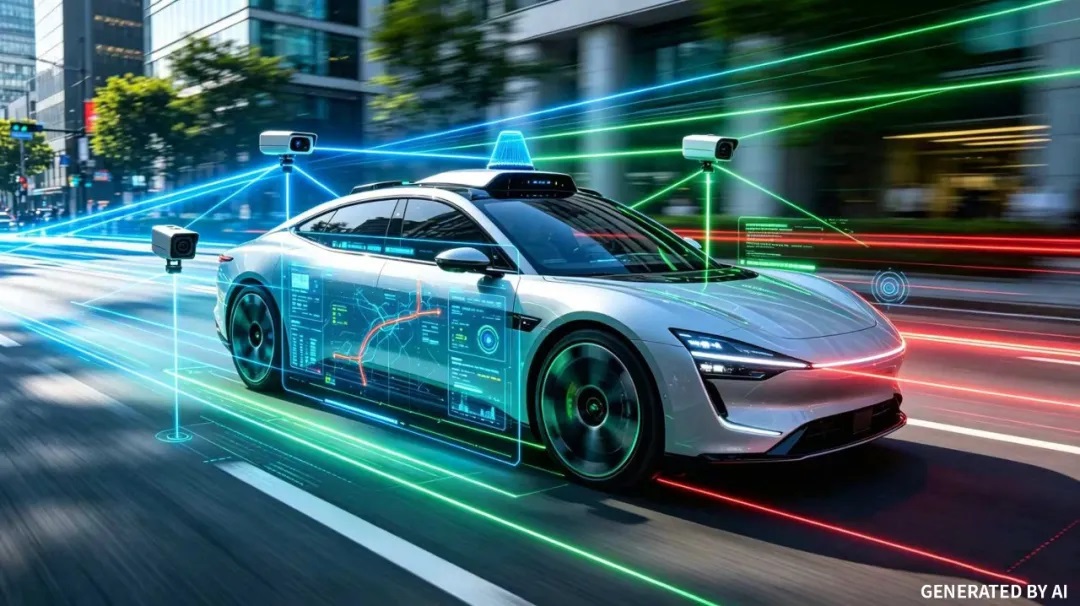
Intelligent driving is essentially a real-time decision-making system based on multi-sensor fusion. Cameras, millimeter-wave radars and LiDAR are all designed to enable vehicles to rapidly and accurately understand their surrounding environment.
Real-world road conditions, however, are far more complex than laboratory environments. Heavy rain, thick fog, backlighting, tunnels and high-speed lane changes can all interfere with vision and radar systems, causing perception latency or attitude errors.
This means intelligent driving systems must not merely “see”, but “see accurately and perceive steadily”.
Against this backdrop, the value of IMUs (Inertial Measurement Units) has been rediscovered. While cameras and radars handle environmental perception, the IMU functions as the vehicle’s real-time nervous system for motion status. It continuously outputs high-frequency data including acceleration, angular velocity and attitude variation, supplying stable and continuous motion references for the system in complex scenarios.
Within multi-sensor fusion architectures, the IMU serves a critical role as the attitude reference and safety redundancy. As high-level intelligent driving extends into more complicated operating environments, inertial sensors are evolving from auxiliary components into foundational infrastructure within the intelligent driving perception stack.
From Peripheral Perception to Core Component: Rising Importance of 6-Axis IMUs
The global intelligent driving industry is entering a new phase of technological evolution.
The industry once prioritized the ability to perceive external surroundings. Today, the system’s capacity to understand the vehicle’s own motion state is equally essential. Only by combining environmental awareness and motion perception can an intelligent driving system achieve truly stable and safe closed-loop control.
In particular, the rapid advancement of smart cockpits, smart chassis and drive-by-wire technologies has increased the complexity of vehicle electronic systems. A growing number of functions rely on high-precision inertial data for coordinated control.
For instance, smart chassis requires real-time vehicle attitude data; automatic parking demands precise tracking of low-speed motion trajectories; vehicle stability systems need millisecond-scale dynamic feedback; navigation and positioning systems require continuous and stable attitude calibration. All of these factors elevate the importance of 6-axis IMUs.
Meanwhile, the domestic intelligent driving industrial chain is accelerating toward full-stack autonomy and controllability.
From intelligent driving chips and operating systems to LiDAR and core sensors, China’s automotive industry is building a more complete local supply chain. Within this landscape, automotive-grade MEMS inertial sensors are presented with significant development opportunities. On one hand, mass commercialization of intelligent driving creates massive market demand. On the other hand, automakers impose stricter requirements for supply chain stability, local responsiveness and long-term reliability.
This creates new industrial opportunities for local sensor enterprises with independent R&D, automotive-grade mass-production capability and long-standing technical expertise.
Accumulated Automotive-Grade MEMS Expertise: MEMSIC Builds the Foundation for Domestic Smart Perception
As one of China’s early pioneers in automotive-grade MEMS sensors, MEMSIC introduced automotive quality management systems as far back as 2002 and has continuously advanced automotive-focused R&D, manufacturing and quality infrastructure. With over two decades of technical accumulation and market validation, MEMSIC has built a complete MEMS capability portfolio covering R&D design, manufacturing testing, quality management and reliability verification.
Leveraging its long-standing automotive-grade MEMS foundation, MEMSIC’s products are widely deployed across automotive electronics, industrial control, consumer electronics, medical devices, the low-altitude economy and robotics, with cumulative shipments exceeding 4 billion chips.
At the same time, responding to emerging trends including intelligent driving, smart chassis, low-altitude economy and embodied intelligence, MEMSIC continues to define its product roadmap for high-end inertial sensors. The company focuses on high precision, low drift, superior stability, miniaturization and high integration to further strengthen the underlying domestic smart perception capabilities.
Moving from automotive-grade reliability toward system-level perception capabilities, MEMSIC draws on decades of MEMS expertise to deliver a stable, reliable perception foundation for China’s domestic intelligent driving industry.
From an industrial perspective, future competition in intelligent driving will no longer be limited to individual chips or standalone algorithms. Instead, it demands full coordination across perception, control, computing power and systems engineering.
China’s intelligent driving sector is building a more comprehensive underlying technology ecosystem, advancing from chip autonomy toward perception autonomy. Domestic high-end sensor enterprises represented by MEMSIC continue to build technical expertise and automotive-grade capabilities, delivering a more stable and reliable perception foundation for China’s intelligent driving industry.